
Brickwork and Stonework Restoration
DOFF superheated steam cleaning, lime repointing and masonry repair, on facades that cannot take abrasion or chemicals.
London stock brick is soft. It has a fired outer skin perhaps two or three millimetres thick, and once that skin is gone the brick behind it absorbs water and decays. Most facade cleaning available on the open market removes that skin. This page explains the method we use instead, and why the pointing usually matters more than the cleaning.
Three photographs of brickwork before and after repair.
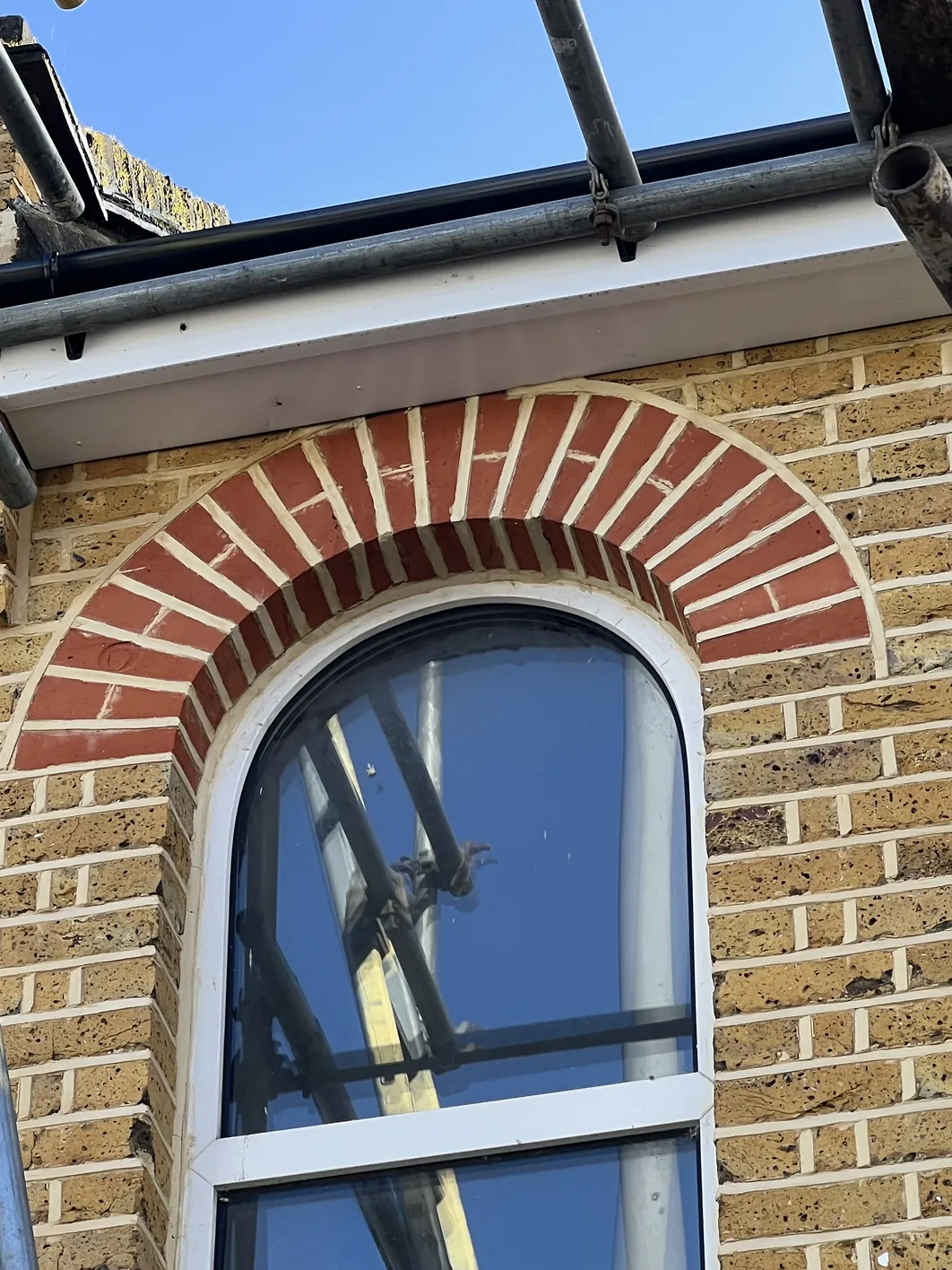
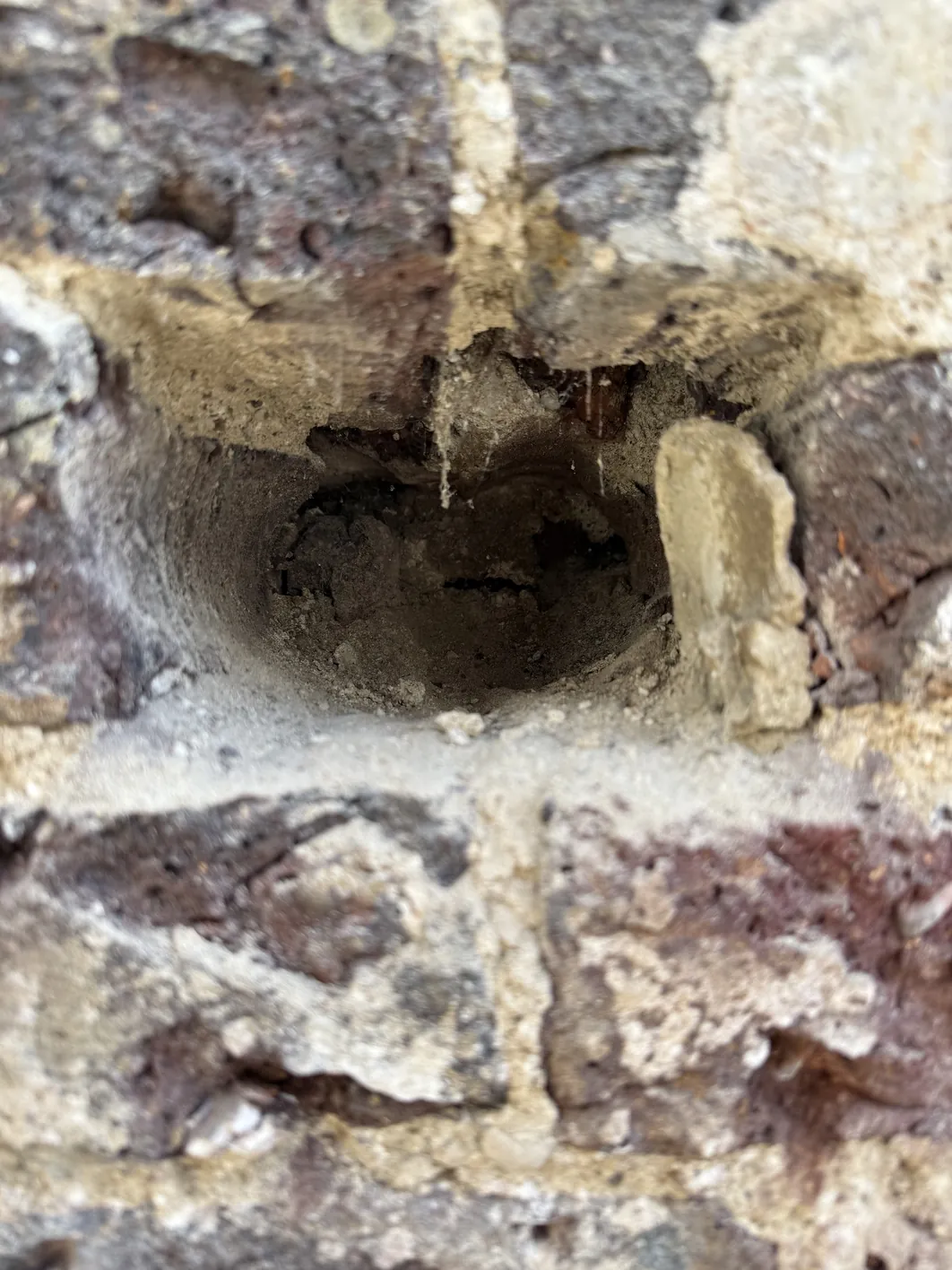
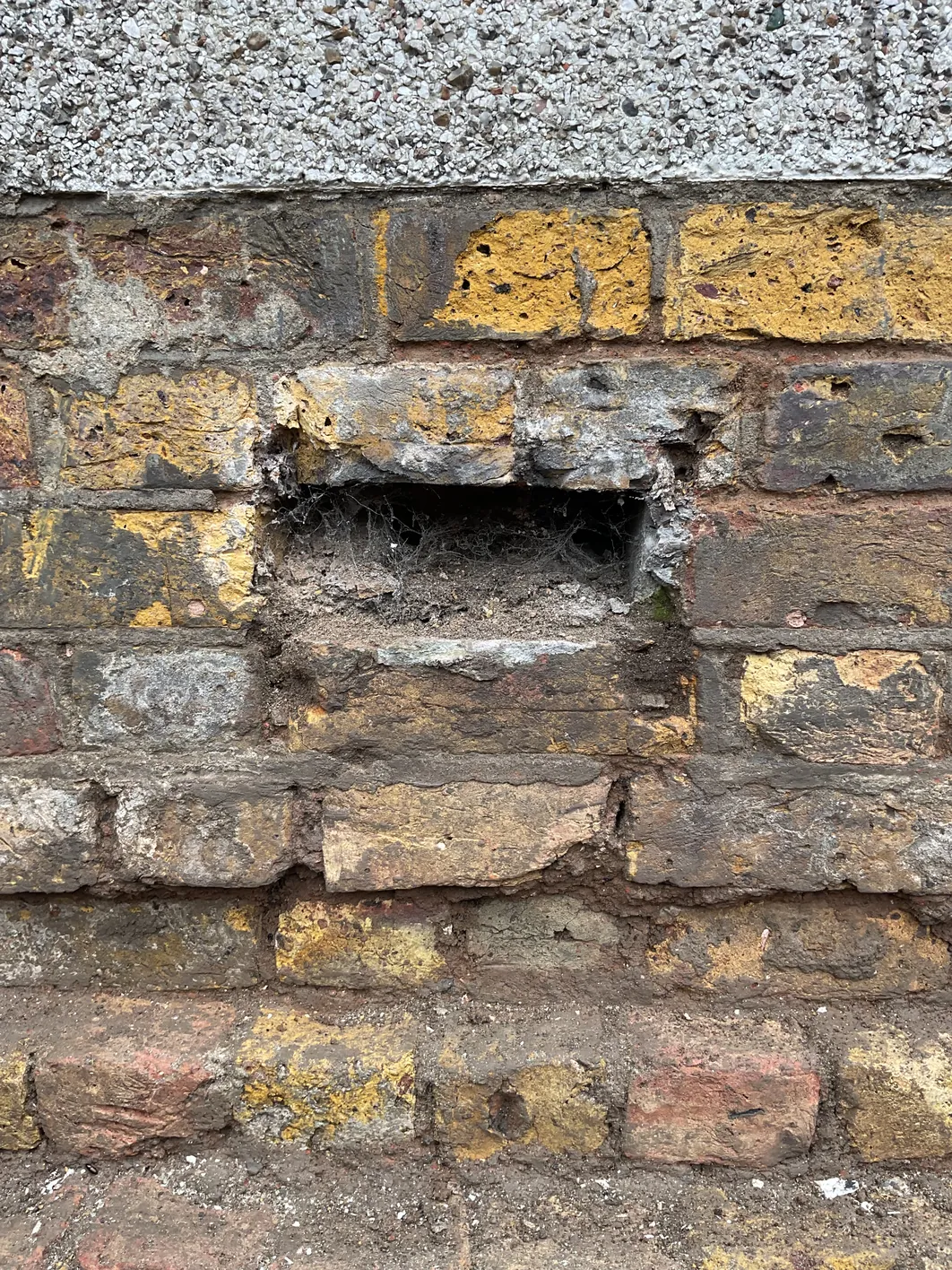
Overview
A dirty facade is usually the presenting complaint. It is rarely the actual problem.
By the time a London terrace looks tired, the pointing is generally at or past the end of its life, there may be cement repairs from previous decades doing active damage, and some proportion of the brick faces will have spalled. Cleaning a wall in that condition without addressing the rest produces a clean wall that deteriorates faster, because you have removed the soiling that was partially sheltering it and left every underlying defect in place.
We treat the facade as one job: assess, clean appropriately, repair and repoint, in that order.
DOFF Cleaning
How It Works
The DOFF system uses superheated water in a steam and low-pressure water mixture, delivered through a fine nozzle. The temperature at the nozzle is high; the pressure at the surface is low, and that combination is the whole point.
Heat does the cleaning. Soiling, biological growth and many paints and coatings break down thermally, so they can be lifted without the mechanical force that would remove the brick's fired surface with them. Because it is low pressure, the substrate is not eroded. Because it uses only water, there is no chemical residue left in the masonry to cause problems later.
Why it suits London masonry
- No abrasive medium, so the fired skin of the stock brick survives
- No chemicals, so no salts are introduced into a wall that likely already carries some
- Low water volume, so the wall is not saturated and dries quickly
- Kills biological growth thermally rather than suppressing it with biocide
- Accepted for use on listed and conservation-area buildings, subject to consent and trial areas
What It Removes
General atmospheric soiling and carbon deposits, algae, moss and lichen, most masonry paints and limewash where removal is wanted, bitumen and adhesive residues, and graffiti in many cases. Efflorescence can be reduced, though salt on a facade indicates a moisture path that needs finding rather than just cleaning off.
What cleaning will not do is restore a brick whose face has already spalled. That brick needs cutting out and replacing, or in some cases turning. Setting expectations on this before a scaffold goes up avoids disappointment when the wall comes clean and the damage becomes visible for the first time.
We always agree a trial area first. Facades vary, and a small test panel establishes what the finish will actually look like before the whole elevation is committed.
Why Not Sandblasting or Chemicals
| Method | What it does to soft brick |
|---|---|
| Grit or sand blasting | Removes the fired skin along with the dirt. The exposed body is porous and soft, absorbs far more water, and decays and spalls from the first frost onward. The damage is permanent and it accelerates. |
| High-pressure water jetting | Erodes both brick face and mortar joints, and drives large volumes of water deep into a solid wall that then takes months to dry, mobilising salts as it goes. |
| Acid-based chemical cleaning | Etches the surface, and leaves salt residues in the masonry that continue to crystallise and cause damage long after the contractor has left. Frequently produces staining that is worse than the original soiling. |
| Painting over it | Masonry paint on soft brick traps moisture, spalls the face beneath, and creates a maintenance liability that gets more expensive every cycle. |
Blasted brickwork is unfortunately easy to recognise once you know what to look for: an unnaturally uniform, matte, slightly pitted surface, often with the arrises softened and the mortar joints cut back. It is not reversible.
Repointing: The Part That Matters Most
Pointing is not decorative. The mortar joint is the sacrificial element of a masonry wall and it is where the wall is designed to breathe. On a typical London terrace the joints represent a substantial proportion of the wall's surface area, and they are the primary route by which moisture leaves.
Why Cement Pointing Destroys Brick
Repointing soft brickwork in cement mortar is extremely common and reliably damaging.
The mechanism
- Cement mortar is harder, denser and less permeable than both the original lime mortar and the brick
- Moisture that would previously have evaporated through the joint can no longer do so
- It is forced to evaporate through the brick face instead, which is now the weakest available path
- Salts crystallise at the brick surface rather than in the joint, and the face blows
- Freeze-thaw acts on the saturated brick face rather than on the sacrificial mortar
- Within a few decades the joints are intact and the bricks are eroded back behind them
The visual signature is a wall where the mortar stands proud in a grid and the brick faces are recessed. That wall has been damaged by its own pointing.
Lime mortar inverts the relationship. It is weaker than the brick, so it takes the weathering, the salt crystallisation and the movement. When it eventually erodes, you repoint, which is routine maintenance costing a fraction of cutting out and replacing brick faces.
Mortar Matching and Joint Profile
A repointing specification is a matching exercise, not a default recipe. Getting it right means assessing the existing mortar for binder type, aggregate, colour and strength, and matching the new mix to it and to the brick, rather than to a bag.
- Binder. Selected against exposure and background strength, and kept softer than the brick. The reasoning is the same as for render and is covered in our binder paper.
- Aggregate. The sand governs colour and texture more than the binder does. Matching it is what makes a repointed panel disappear rather than read as a repair.
- Joint preparation. Raking out to a sufficient depth, by hand where the brick is soft. Angle grinders widen joints and cut brick arrises, and the damage is visible for the life of the wall.
- Profile. Matching the original. Weatherstruck, flush and bucket-handle profiles all behave differently, and a ribbon or strap pointing that stands proud of the face sheds water onto the brick rather than away from it.
In practice that means mixing on site rather than buying a repointing mortar. The binders we gauge from are natural hydraulic lime, usually NHL 3.5 for general repointing and making good, and non-hydraulic hydrated lime where the brick is soft enough to need a mortar with no chemical set at all. The distinction is not academic: hydrated lime hardens purely by carbonation, absorbing carbon dioxide over weeks to months, which is slow but produces the softest, most sacrificial and most forgiving joint available. It is also what gives a mix its workability and water retention, the property bricklayers call fattiness, and it is why a well-gauged lime mortar can be worked into a joint properly instead of being buttered onto the face.
Where salts or a high-suction background are in play we gauge further, with a pozzolan such as Trass for sulphate resistance and a plasticiser for water retention. The full set of mixes and systems is listed on the build-ups page.
Technical reading
Hydraulic vs Non-Hydraulic Lime in Retrofit Projects. Binder chemistry, NHL grades, and why over-specifying strength damages historic masonry.
Stonework
The same principles govern stone, with the added complication that stone types vary enormously in hardness, porosity and how they respond to heat and water. London facades commonly combine stock brick with Portland stone or limestone dressings, York stone at thresholds and steps, and sometimes render bands imitating stone.
DOFF is suitable for most of these, at settings adjusted per material, which is why the trial area matters more on a mixed facade than on plain brickwork. Limestone in particular develops a hardened surface layer over time, and removing it exposes softer material that then weathers rapidly. Cleaning stone is a decision about how much patina to remove, not simply how clean to get it.
Sequencing a Facade
- Survey. Condition of brick and stone, condition and type of existing pointing, extent of cement repairs, spalled units, moisture paths, defective rainwater goods. Photographs and a schedule of what needs doing.
- Consents. Listed building consent or conservation area considerations where they apply. We will tell you if you need them.
- Trial area. Agreed and signed off before general cleaning starts.
- Clean. DOFF at settings established by the trial.
- Rake out. Defective pointing removed to depth, by hand where required.
- Brick and stone repair. Spalled units cut out and replaced with matched reclaimed material where possible.
- Repoint. Matched lime mortar, correct profile, protected while curing.
- Rainwater goods. Because a repointed elevation under a leaking downpipe will not stay sound.
Cleaning before repointing rather than after is deliberate: it reveals the true condition of the joints and the bricks, so the repair schedule is based on what is actually there.
What the Render Was Hiding
On a south London elevation, hacking off the cement render showed that the window and door lintels were both sound but the outer three courses of facing brick in front of them were not supported. We rebuilt the first two courses on mechanical brackets and, at the third course in the window zone, installed insulation rather than rebuilding unsupported brick, which keeps the build-up breathable and takes future movement out of the place most likely to crack.
Survey and Site Control
Facade work is judged on the finished elevation, but it is decided by the survey and protected by the site setup. Both are worth being specific about, because they are where a careful contractor and a cheap one diverge before a single joint is raked out.
Surveying
Alongside the condition schedule and photographs, we 3D scan at survey stage where the elevation justifies it. A point cloud gives measured geometry for an irregular historic facade, which matters when quantities are being agreed, when units need cutting to match, and when a bay has settled and nothing on it is square. It also gives an unarguable record of the condition on the day we arrived, which protects both sides.
Quantities come off that survey as square metres by elevation and by phase, so the schedule states how much work is where rather than how many days someone expects to be on site. It is a more honest unit and it is checkable against the finished wall.
Protection and Site Setup
- Correx and zip-door protection. Floors, joinery and thresholds sheeted, and dust-sealed zip doors between the work and the rest of the building. On an occupied house this is the difference between a facade job and a facade job plus a redecoration.
- Propping. Acrow props where units are being cut out below anything that needs supporting. Cutting out a spalled unit under load without propping is how a localised repair becomes a structural one.
- Scaffold and sheeting. Sheeting stays up through the curing period, not just the application, because a repointed joint is vulnerable to frost, sun and driving rain long after it looks finished.
- Ventilation. Air movers and ducting for internal work, and forced-air ventilation set up and left running when we leave site, because lime carbonates on its own schedule.
- Drawings. Where an architect is involved we work to their details and their revision numbers, and we record which revision each area was built to.
None of that is glamorous and none of it shows in a photograph of a finished elevation. It is most of the difference in how the job feels to live through, and a fair amount of the difference in how it looks in ten years.
Cost and Scope
A facade is priced on survey, because the variables are elevation area, access and scaffold, the extent of repointing, how many units need replacing, and whether previous cement repairs have to be removed.
| Service | Typical context |
|---|---|
| Brickwork cleaning | DOFF steam cleaning of soiled or painted brick facades |
| Stonework cleaning | Portland, limestone and York stone elements |
| Repointing | Lime mortar matched to the existing brick and joint |
| Lime rendering | Where the elevation is to be rendered rather than exposed |
| Refurbishment mission plan | A strategy for the building, whether or not you use us |
Next step
Get a quote, or call +44 7468 865983. For a facade in unclear condition, a free Refurbishment Mission Plan is the sensible starting point.
Common Questions
Is DOFF cleaning safe for soft London stock brick?
Yes, which is exactly why it is accepted for listed and conservation-area work, subject to consent. It uses no abrasive and no chemicals, so the brick's fired skin survives and no salts are introduced into a wall that may already carry some, and the low water volume means the wall is not saturated and dries quickly afterwards.
Why not sandblast or use chemical cleaners?
Because the damage does not announce itself straight away, and it cannot be undone once it has. Sandblasted brick develops an unnaturally uniform, slightly pitted look that is easy to spot once you know it, with softened arrises and cut-back joints, and by the time it is visible the fired skin protecting the brick underneath is already gone for good.
Why is cement pointing damaging to old brickwork?
The tell is visible from the pavement: a wall where the mortar stands proud in a grid and the brick faces sit recessed behind it has been damaged by its own pointing. Cement is harder and less permeable than the brick, so moisture that used to leave through the joint is forced out through the brick face instead, and salt crystallisation and freeze-thaw do the rest.
Further Reading
- Build-ups, the specified assemblies and the materials named in full
- Hydraulic vs Non-Hydraulic Lime in Retrofit Projects
- Why Breathable Walls Crack
- Lime rendering, where the elevation is to be covered rather than exposed
- Wall remediation, where failed pointing is causing internal damp
- All technical white papers
Guidance on cleaning and repointing historic masonry is published by Historic England, the Society for the Protection of Ancient Buildings and the Building Limes Forum. Our white papers carry full references.