
Damp and Wall Remediation
Diagnosis before treatment, and breathable repair rather than chemical injection.
Damp is a symptom. Treating the symptom without identifying the cause is why so many London homeowners have paid for the same wall twice. This page sets out how damp is actually diagnosed, why the two most commonly sold treatments frequently make solid walls worse, and what a durable repair looks like.
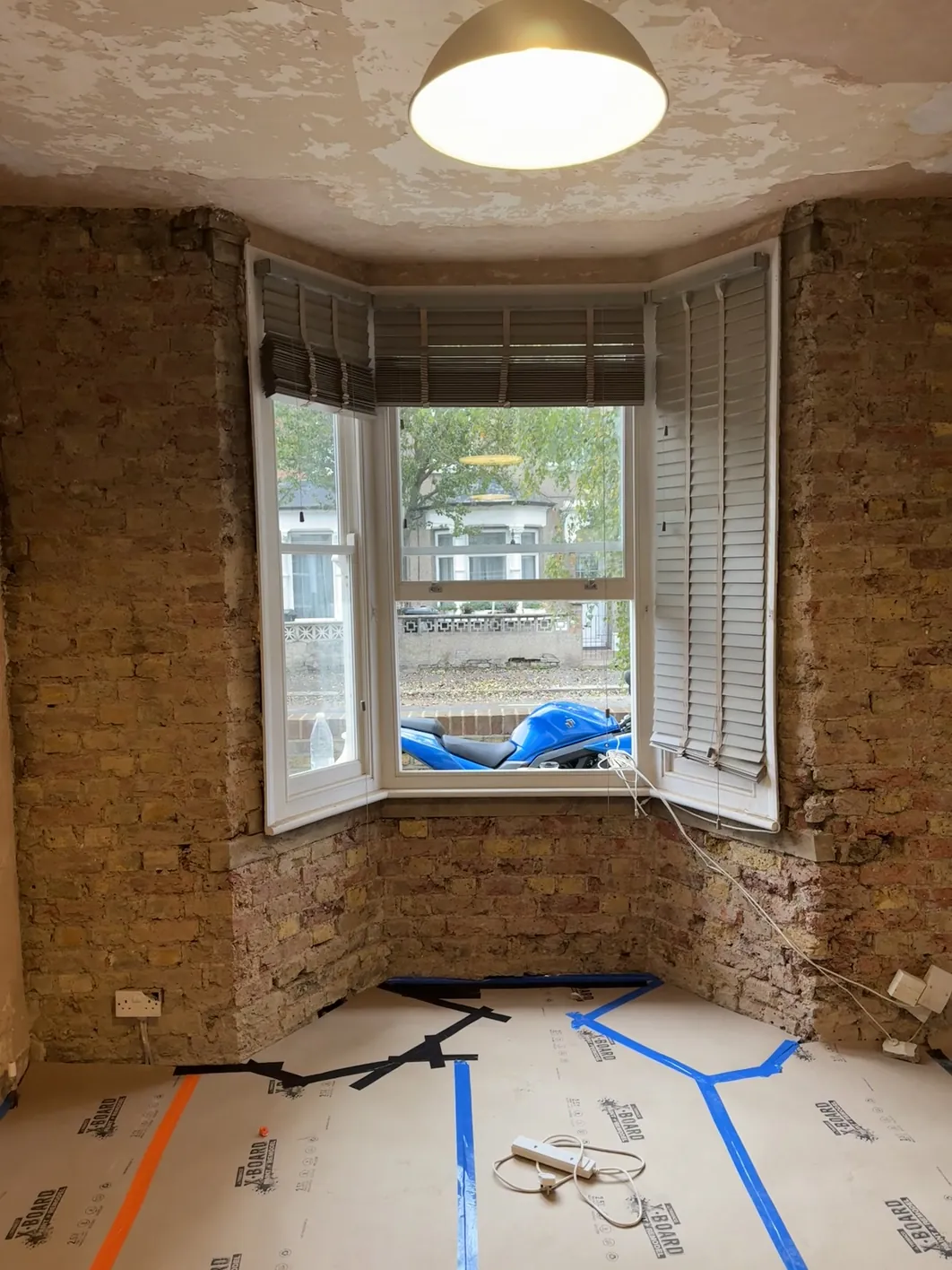
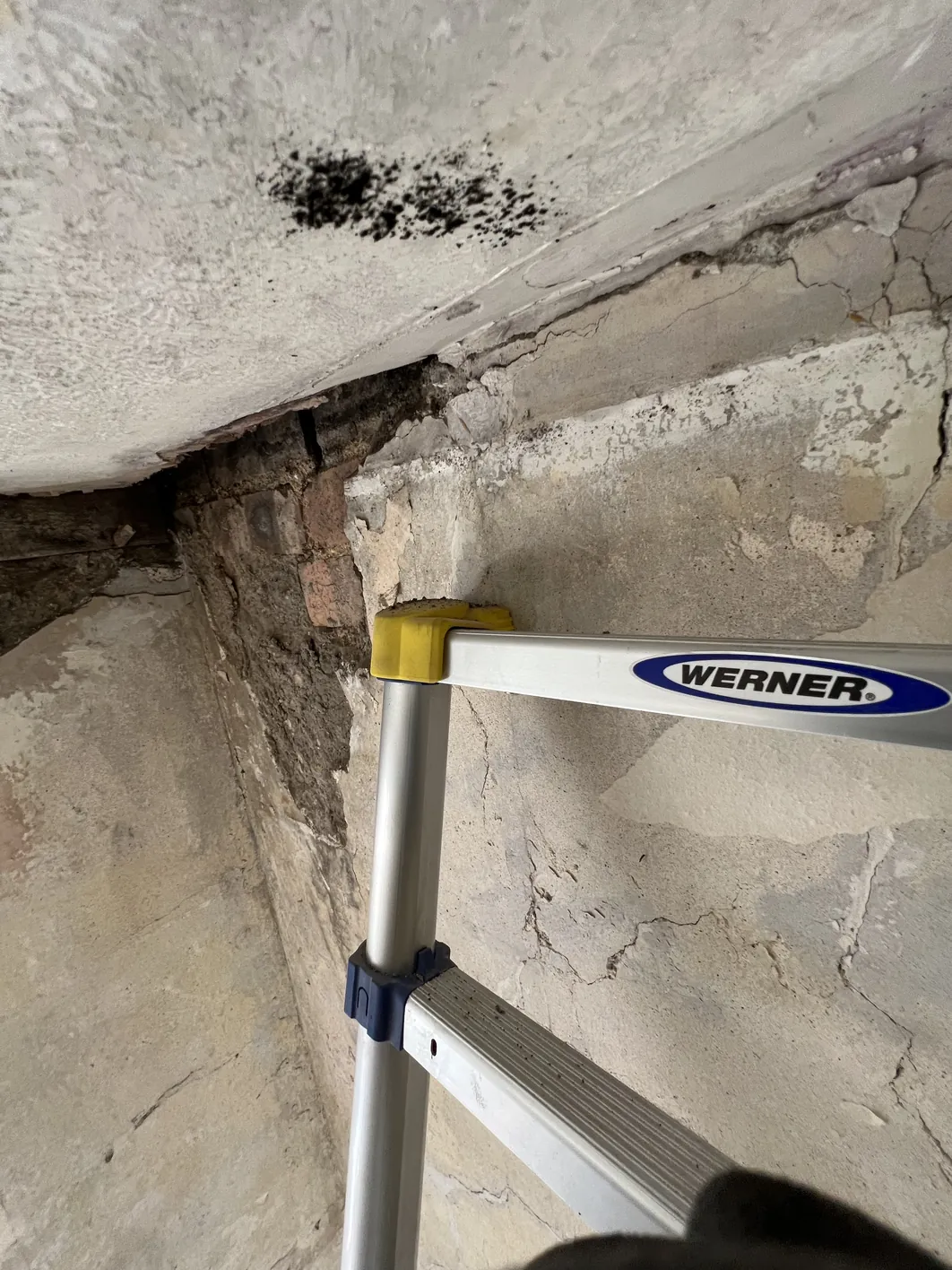
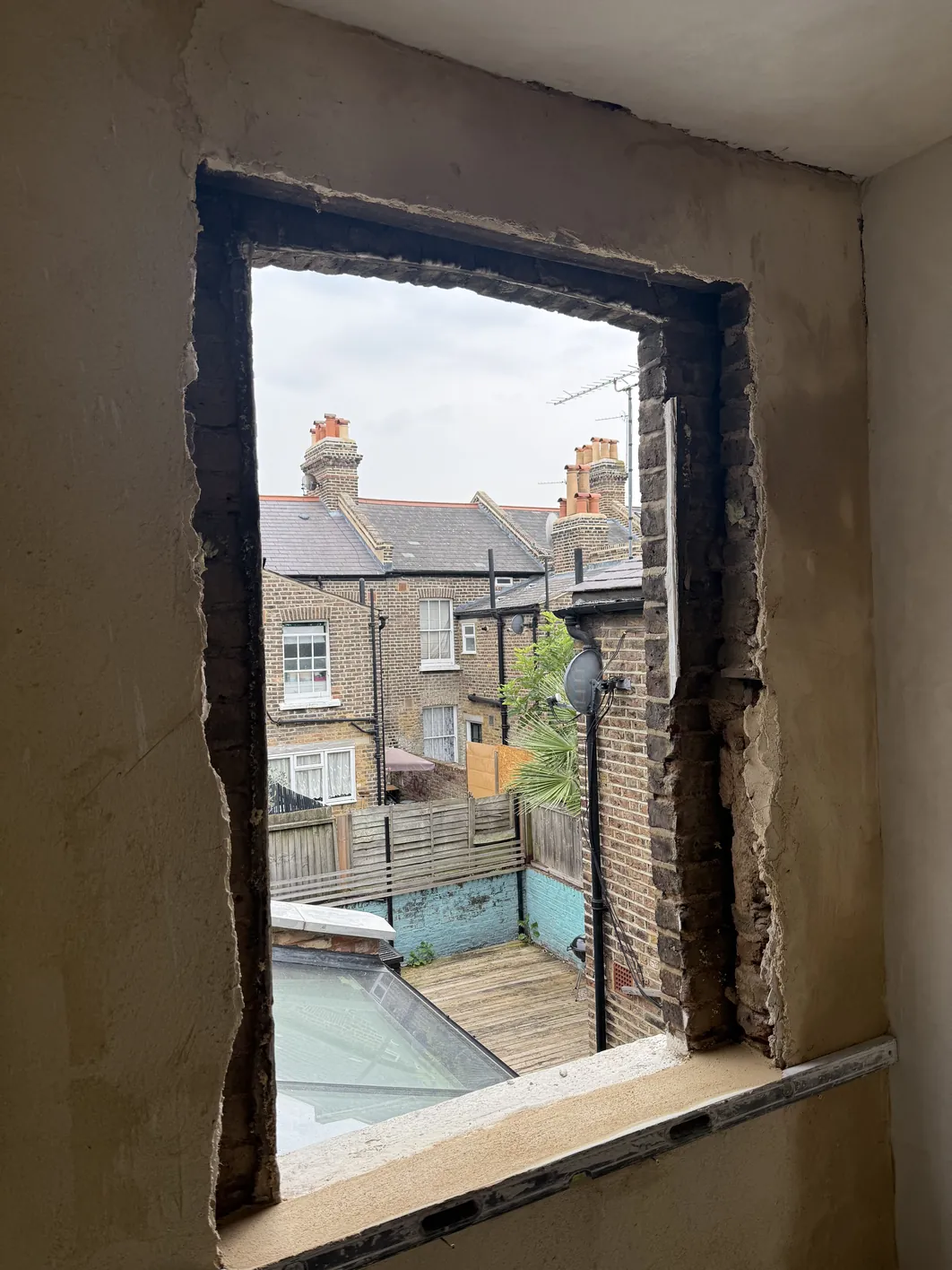
Three photographs from remediation jobs: what the wall looked like, and what was behind it.
Overview
A damp patch is evidence, not a diagnosis. The same stain on the same wall can be produced by at least five different mechanisms, each requiring a different response, and several of them are made worse by the treatment most commonly sold for the others.
The damp-proofing industry is structured around selling a product. If the product is injection, the diagnosis tends to be rising damp. We do not sell a product, so the diagnosis comes first and sometimes the answer is that the wall needs nothing beyond fixing a gutter.
The Five Causes, and How They Differ
| Mechanism | What it looks like | What actually fixes it |
|---|---|---|
| Penetrating damp | Patches at any height, worse after rain, often traceable to a specific external defect | Repair the defect: pointing, render, flashing, gutter, downpipe, sill |
| Condensation | Mould in corners, behind furniture, on cold external walls and reveals; worst in winter | Ventilation, heating pattern, insulation of cold surfaces, moisture-buffering finishes |
| Building defect | Localised, often sharply defined; raised external ground, bridged DPC, leaking pipe | Remove the bridge, fix the leak, lower the ground level |
| Hygroscopic salts | Tide marks, blown plaster, damp that fluctuates with indoor humidity rather than rainfall | Remove contaminated plaster, poultice where needed, replaster breathable |
| True rising damp | Even band rising from floor level, consistent height across a wall | Genuinely uncommon; where present, address the ground and the wall's ability to dry |
In our experience the last of these accounts for a small fraction of the cases we are called to, and the first four account for nearly all of them. That distribution matters, because it is close to the inverse of what gets treated.
Two Treatments That Usually Make It Worse
Chemical DPC Injection
Injection introduces a water-repellent chemical into a drilled course of masonry, intended to form a barrier against capillary rise. Set aside for a moment whether it forms a continuous barrier in irregular historic brickwork, which is itself contested. The more immediate problem is that it addresses only one of the five mechanisms above, and that mechanism is the least common one.
If the wall is wet from a failed gutter, injection changes nothing. If it is wet from condensation, injection changes nothing. If it is wet because groundwater deposited salts in the plaster decades ago, injection changes nothing, though the replastering specification that usually accompanies it, typically a dense cement render with a waterproofer, will hide the symptom for a few years by trapping moisture deeper in the wall.
That is the part worth understanding: the guarantee often covers the plaster, not the wall.
Cement Render and Waterproof Tanking
Cement is much less vapour permeable than the soft brick and lime mortar of a London terrace. Applying it to a solid wall, inside or out, does not stop water entering. Water still enters through cracks, through defects, through the exposed face and up from the ground. What changes is that it can no longer leave at the rate it arrives.
The failure sequence, which typically takes several years
- Moisture concentrates behind the impermeable layer instead of evaporating
- It migrates upward and sideways, so damp appears above or beside the treated area
- Soluble salts are carried to the interface and crystallise there
- Crystallisation pressure debonds the render from the masonry, often audible as hollowness
- Trapped water in a soft brick face freezes and spalls the brick, which is permanent damage
- The render cracks, admits water directly, and now performs worse than no render at all
The damage to the brickwork is the part that cannot be undone. Render can be removed. A spalled Victorian stock brick face cannot be put back.
Salt Contamination
Salt is the reason so many damp repairs fail after the source has genuinely been fixed.
Groundwater and, in London, historic contamination from coal, chimney flues and old drainage carry soluble nitrates, chlorides and sulphates into masonry. Water evaporates at the wall surface; the salts do not, and they accumulate in the plaster and the outer few millimetres of brick.
Those salts are hygroscopic, meaning they draw moisture directly from humid air. A wall contaminated with them will read damp on a meter and feel damp to the touch on a wet week even though no liquid water is reaching it any more. Redecorating fails within a season, because the salts are still there under the paint.
The treatment is removal, not concealment: taking contaminated plaster off back to sound masonry, poulticing the masonry where contamination is heavy to draw salts out, and replastering in a breathable system that lets any residual movement continue harmlessly.
How We Diagnose
A diagnosis that begins with a conductance meter and ends fifteen minutes later is not a diagnosis. Conductance meters respond to salts and to conductive materials as readily as to water, which is precisely why they so often read high on a wall whose problem is contamination rather than active wetting.
- External inspection first. Ground levels, pointing, render condition, gutters, downpipes, flashings, sills, air bricks. Most penetrating damp has a visible external cause and it is usually cheaper to fix than anything internal.
- Pattern and history. Where is it, how high, how sharply defined, does it change with rainfall or with indoor humidity, when did it start, what work was done before it started.
- Moisture assessment. Surface readings interpreted with proper scepticism, and deeper assessment where the answer matters.
- Salt assessment. Because it determines whether plaster can stay.
- Internal conditions. Heating pattern, ventilation, occupancy, extract fans, and whether the building is being asked to do something it cannot.
The output is a written explanation of what is happening and why, and it stands on its own whether or not we do the work.
The Repair Sequence
- Stop the source. Nothing else is worth doing first. A gutter repair may be the whole job.
- Let it dry. A solid wall that has been wet for years takes months to dry, roughly a month per twenty-five millimetres of thickness under reasonable conditions. Replastering a wet wall traps the problem.
- Remove contaminated material. Plaster carrying salt is taken back to sound masonry.
- Treat the masonry. Poulticing where salt loading justifies it, repointing where the mortar has failed.
- Replaster breathable. A lime system that allows the wall to continue drying and moving. See lime plastering.
- Decorate permeable. Limewash, distemper or mineral paint. A vinyl emulsion at this stage undoes the whole repair.
Specifying the Mix to the Wall
Step five above says “a lime system”, which is where most specifications stop and where the interesting decision actually begins. A bagged product is a single answer to a general question. A damp wall that has been wet for years, carries salt, and is being asked to keep drying is a specific question, and sometimes the honest answer is to mix for it rather than buy for it.
On walls where that applies we gauge a site mix: natural hydraulic lime with Trass and Mystolene, applied as a rinzaffo, the thin high-suction key coat that goes on before the render proper. The reasoning behind each component:
| Component | What it does | Why it matters on a damp wall |
|---|---|---|
| Natural hydraulic lime | The binder, setting partly by hydraulic reaction and partly by carbonation | Gives an early set on a wall that will not dry quickly, while staying vapour open |
| Trass | A volcanic pozzolan, gauged into the mix | Improves sulphate resistance, which is the specific risk where salts are present, and refines the pore structure |
| Mystolene | A plasticiser affecting workability and water retention | Stops a high-suction background pulling water out of the coat before it has set, which is what causes a rinzaffo to dust off |
None of that is exotic, and none of it is a secret. It is simply the difference between specifying to the substrate and specifying to a product catalogue. The test of a remediation contractor is whether they can tell you why the mix in front of you is the mix for your wall, and a contractor who answers every wall with the same bag has not been asked the question yet.
The same reasoning applies to the finish. Where a manufactured system suits the wall better we use one, and we say which and why: a cork and lime thermo-plaster carries a vapour resistance factor of µ 4 and around 71 per cent porosity, which is a genuinely open assembly, whereas a cement render on the same wall will hold the moisture in and push it somewhere less convenient. The build-ups page lists the systems and mixes we specify, with their layers and thicknesses.
What We Find on Opening Up
Remediation is the service where the wall most often turns out to be a different job from the one quoted. On an east London terrace, damp at the skirting line and a cement-rendered rear wall proved to be the same problem from two sides, and the answer was a site-mixed perlite insulating coat rather than anything from a bag. On a south London elevation, stripping the cement render revealed that the outer three courses of facing brick across the lintel line were carrying nothing except the render we had just removed.
Neither was visible before opening up, and both are the reason we quote the investigation separately from the repair.
Case studies: damp and a site-mixed perlite coat, and the brickwork behind the render.
When to Monitor Rather Than Intervene
Not every damp reading justifies work. Solid walls take up and release moisture seasonally, and a wall that reads elevated in February and normal in July is behaving as designed rather than failing. Intervening on a single winter reading is how sound plaster gets removed unnecessarily.
Where the picture is ambiguous, monitoring across a season costs nothing and frequently changes the answer. The same logic applies to cracking, which is often the first thing a homeowner notices and the thing most often misread:
Technical reading
Why Breathable Walls Crack. A risk-based framework for telling harmless drying shrinkage and seasonal movement apart from moisture problems and structural defects, including guidance on monitoring before intervention.
Common Questions
Do I need a chemical damp-proof course injection?
Usually not: in our experience true rising damp accounts for a small fraction of the damp we are called to, and injection does nothing for the other four mechanisms, penetrating damp, condensation, building defects or salt contamination, which make up nearly all of it. See the table above for how to tell which one you actually have.
Why is cement render bad for a solid wall?
It traps water it cannot let out. The part worth remembering when deciding whether to remove it: everything cement render does can be undone except the damage to the brick face underneath, which is permanent once it has spalled.
What causes tide marks and blown plaster near the skirting?
Usually hygroscopic salts rather than an active leak, and the tell is that it tracks indoor humidity rather than rainfall: worse on a muggy week, better in a dry spell, with nothing outside having changed. The contaminated plaster has to come off; redecorating over it fails again within a season.
Can you fix damp without ripping out the whole wall?
Often, yes. Once the source is stopped, work is usually limited to removing plaster back to sound, salt-free masonry rather than the whole wall. What decides the extent is how far the contamination has actually spread, which the salt assessment step in our diagnosis is there to establish, not a general rule about minimising disruption.
How long before the wall can be decorated?
Longer than most people expect. The wall has to dry out fully first, at the rate given in the repair sequence above, and only then can new lime plaster go on and carbonate before it is ready for a permeable decoration. Plan in months rather than weeks on a wall that has been wet for years.
Further Reading
- Build-ups, the specified assemblies, including the site-mixed render options
- Why Breathable Walls Crack
- Hydraulic vs Non-Hydraulic Lime in Retrofit Projects
- Lime plastering, the breathable replastering that follows remediation
- Lime rendering, where the external face is the source
- Brickwork restoration, where failed pointing is letting water in
- All technical white papers
Next step
Get a quote, or call +44 7468 865983. If you want the diagnosis without committing to the repair, ask for a Refurbishment Mission Plan instead. It is free and gives you a strategy for the building whether you use us or not.
Guidance on moisture in traditional buildings is published by Historic England, the Society for the Protection of Ancient Buildings and the Sustainable Traditional Buildings Alliance. Moisture management in buildings is covered by BS 5250. Our white papers carry full references.